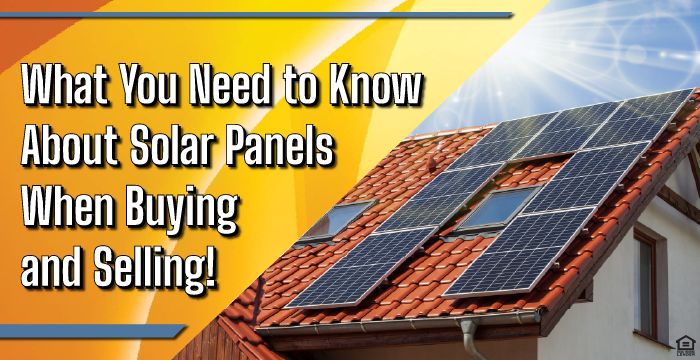

What You Need to Know About Homes with Solar Panels When Buying and Selling

marketingdept • June 17, 2025

What You Need to Know About Homes with Solar Panels When Buying and Selling

Solar panels are a great way to become more environmentally-friendly while saving on your energy bills. Some homeowners have even generated enough electricity to sell some of it back to their power company. Solar panels can be outright owned, leased, financed, or subject to a Power Purchase Agreement (PPA), which is why it’s important to know that the high initial costs of the system can create some unexpected obstacles if you’re looking to buy or sell a home with solar panels. 

Buying a Home with Fully-Owned Solar Panels


If you’re looking for a home with solar panels, you’ll need to be sure that the panels are included with the sale. Many lease agreements allow current owners to remove the panels and install them at a new property, so buying a home with a fully-owned system would be your ideal plan.    If the solar panels are owned outright and there is no loan, they are treated as a fixture of the property and are sold as part of the real estate.    Keep in mind that solar panels cannot be the only source of electricity on the property. All major mortgage investors, including Fannie Mae, Freddie Mac, the VA, and the FHA, require the property to have another source of electricity in case the solar panel system fails.    Your lender may require a copy of the paid-in-full contract and a satisfactory borrower or attorney confirming the contract. With that in mind, Property Appraisals will reference the existence of solar panels, but cannot give a specific value to the panels until it is proven that the panels are owned.   

How Leases, Loans, and Power Purchase Agreements Affect Homes with Solar Panels


If you are buying a home with solar panels that are not fully owned, a copy of the lease, loan, or PPA must be provided to your lender.    For purchase transactions, the lease, loan agreement, or PPA needs to be transferred to the borrower with a fully-signed Transfer Agreement. Signing by the solar company can be a closing condition.   If there is a loan for solar panels associated with a home, the loan itself goes with the property as a lien, and must be transferable to the new buyer.    Solar loans, leases, or PPA’s are usually submitted as a Uniform Commercial Code (UCC) filing. A UCC filing serves as an official public notice stating a creditor’s interest in a piece of property, such as solar panels, as collateral for a debt.   If a UCC has been filed, it must be cleared by the title company to ensure the mortgage’s first lien status. A UCC termination is required unless the title company confirms that the UCC is for fixtures only and can remain on the title. If not, a UCC termination or subordination is required.   

Prepare for Liens if Solar Panels Aren’t Outright Owned 


If you’re not paying for your solar panels outright with cash, the manufacturer may have placed a lien on the property to ensure that you continue paying for them.    Solar loans, leases, or PPA’s are usually submitted as a UCC filing. If a UCC has been filed, it must be cleared by the title company to ensure the mortgage’s first lien status. A UCC termination is required unless the title company confirms that the UCC is for fixtures only and can remain on the title. If not, a UCC termination or subordination is required.    Any lien that has been filed in connection with the panels must be subordinated to the mortgage at closing or it must be removed of record and can be re-filed after closing. While some manufacturers will temporarily remove the lien in the case of a sale, if you are still paying off the balance of the solar panels, there could be a lien on the home until the system is fully paid off.   

Qualifying for a Mortgage with a Solar Panel Lease Payment


If you’re making a monthly lease payment for your solar panels, this payment is included in your debt-to-income (DTI) ratio during the mortgage qualification process. However, if your payments are subject to a Power Purchase Agreement (PPA), they do not have to be included in your DTI.    These monthly lease payments can be excluded from your DTI under very specific circumstances: 
  • If the lease agreement guarantees a specific amount of energy over a given timeframe and the solar panels have failed to meet those goals, the lease payments may be excluded from your DTI.
  • If you pay a rate based on usage of your solar panels, much like other utilities, it may be excluded from your DTI. 
  If you’re currently financing your solar panels, any payments must be included in your debt-to-income ratio. These payments are accounted for like any other debt, so it’s important to recognize that larger loans (with larger payment amounts) can lower the size of mortgage you can qualify for.   

Closing Thoughts

Solar panels are an attractive addition for many homes and being an educated buyer means that you’re prepared for every circumstance. However, it’s important to weigh the pros and cons of a solar panel system, especially if it isn’t fully-owned. Always check with your lender to know what needs to be provided, and how solar panels can affect how you qualify for a loan.

April 8, 2026
For first-time buyers, the spring market can feel exciting and overwhelming, but it's important to find ways to balance your budget and honor your must-haves.

April 6, 2026
How to prepare for applying for financing as a small business owner, including important documents, planning strategies, and more.
March 18, 2026
Spring is one of the busiest times in the housing market, but along with the buzz comes a handful of myths that can hold you back—or cost you more than you expect.
March 18, 2026
How to compete in the spring housing market without overpaying, including Value Assurance, a way to strengthen your offer without taking on additional risk.

March 11, 2026
While owning a home certainly comes with expenses, the IRS offers several deductions and credits that can help reduce your taxable income.

March 3, 2026
Learn how the new mortgage privacy law reduces trigger leads and unwanted mortgage calls starting March 5, 2026, and what it means for homebuyers.
February 24, 2026
Here is a comprehensive guide of everything homeowners need to know before filing their 2026 taxes, including deductions, important forms, rental income, and more.
February 11, 2026
Value Assurance is a mortgage program that helps you make competitive offers by providing an estimated property value before you submit your actual bid.

February 4, 2026
What does it mean when a house is up for auction? Learn why homes go to auction, auction types, how the process works, risks, and what buyers should expect.

January 28, 2026
Designed for medical professionals, physician mortgages can help you get there sooner, with fewer barriers and more flexibility than traditional home financing.

Show More